Two numbers set almost every shading decision here. At noon on the longest day the sun sits about 86° above the horizon — near enough straight overhead. Six months later it sits at about 40°, low enough to come in under every eave you own.
One
Why this suburb is its own problem
Hyde Park was declared a residential area in 1955 and has never stopped building. A founding-era house with deep verandas and tall timber-framed windows sits a few gates from a recent cluster with a frameless glass corner, and the two want opposite answers.
Two things are close to local defaults. The big open-plan living wing faces north onto the garden and pool, because north is where the sun is in the Southern Hemisphere. That wing is usually the entertainment area too, so it has to work at eleven in December and four in July — and one fabric rarely does both.
Two
The light here, by the numbers
Hyde Park sits at roughly 26°11′ south, 28°02′ east, about 1,700 m above sea level. At solar noon on 21 December the sun reaches around 86°; on 21 June, around 40°. The longest day runs 13 hours 47 minutes, the shortest 10 hours 30.
The consequence people find counter-intuitive: a north window with a decent overhang largely shades itself at midday in midsummer and is completely exposed in midwinter. North rooms here are a winter glare problem, not a summer one. Johannesburg's sunniest month is July, at roughly 284 hours; its cloudiest is February, at about 225.
Schematic, not to scale. The overhang that shades a north window in December does nothing in June.
Where the sun rises and sets matters just as much. In midsummer it comes up at 116° — about 26° south of due east — and sets near 243°. In midwinter it swings the other way: up at 64°, down at 295°. So some windows here take direct sun for four months and none for the other eight, which is why "it only bothers us in summer" is such a common sentence at a measure.
Then altitude: at around 1,700 m there is less atmosphere overhead, and the general rule for ultraviolet is roughly 10–12% more intensity per 1,000 m. We found no measured Johannesburg UV figure worth quoting, but it is why fabric and openness matter more here.
Three
Elevation by elevation
N North — the winter problem
Deep, low glare across floors and screens roughly May to August, right in your eyes at a dining table. Sunscreen at low openness is usually the answer; blockout defeats the point, because in winter you want the heat — just not the beam.
W West — the hard one
Low, late, horizontal sun at the hottest part of the day, arriving under every overhang — and in summer from west-south-west, so it rakes the pool deck too. This is where stopping heat outside the glass earns its keep.
E East — bright, brief, manageable
Strong low sun for two or three hours, then nothing. Bedrooms this side wake you early in December, when sunrise is before six. Blockout or a double roller settles it.
S South — quiet, with an exception
No direct midday sun at all — except in midsummer, when sunrise and sunset swing 26° south of the east–west line and clip south-east and south-west windows early and late. Mostly a privacy question.
Overhead is the one orientation where midsummer really is the worst case: in December the sun is within a few degrees of vertical, so a skylight or raked gable takes close to the full load straight down.
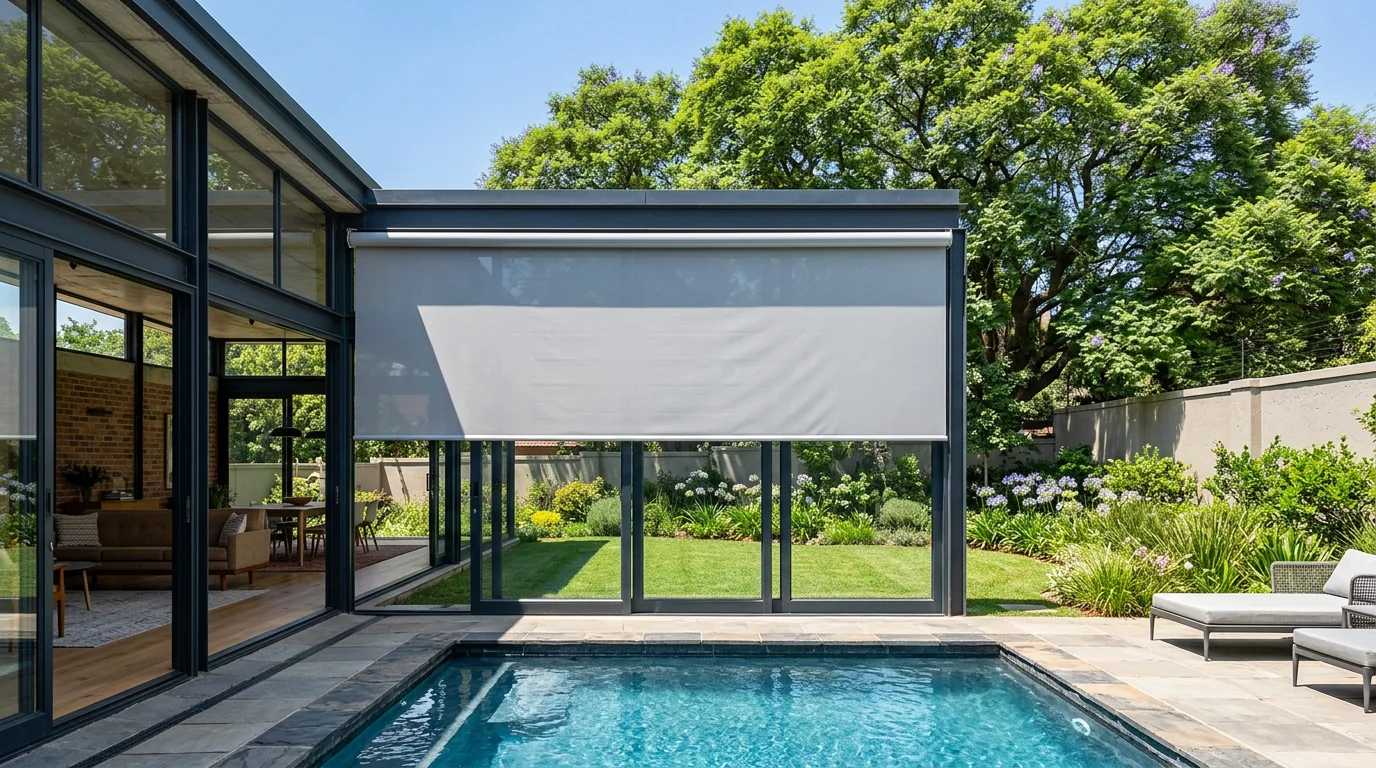
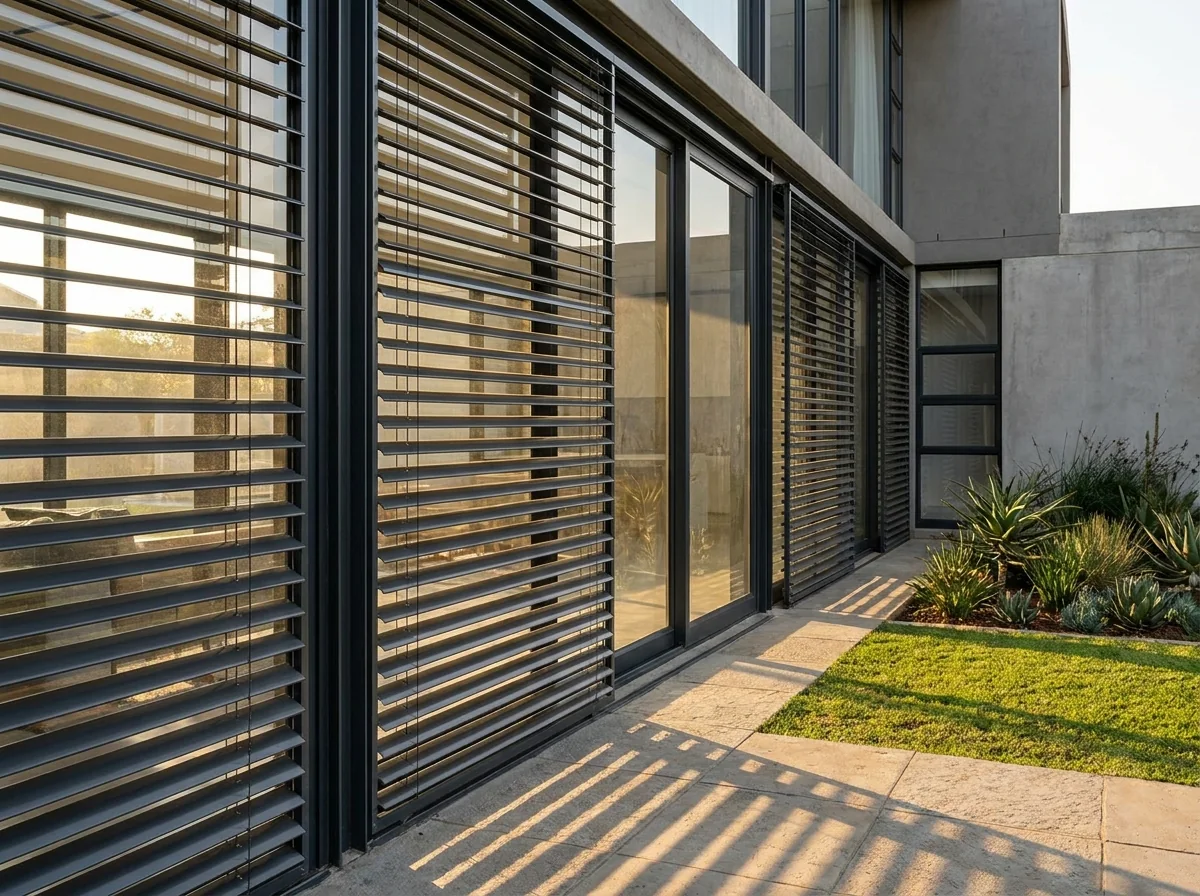
External louvres on a west elevation: outside the pane, so heat is stopped before it is in the room.
Four
What we'd specify, and the honest trade-off
Each is a judgement, not a rule — and where a cheaper product does most of the job, we've said so. The buttons carry any of them into a ballpark or a free measure.
West-facing glass — stop the heat outside the pane
Once solar energy is through the glass it is in the room, and an interior blind can only absorb it and re-radiate it. External venetian louvres intercept it first, and because the slats tilt you keep the view while killing the direct beam. Roller shutters do the same outside-the-glass job with a heavier, more complete closure.
Shading, not security. Our roller shutters are made for sun, heat and glare control on the outside of the glass. They are not security-rated shutters — that is a different product, which we can quote on request.
The trade-off, both ways: exterior systems cost more, need a sound fixing substrate and a wind strategy, and change the elevation — a shutter headbox especially, which is what an architectural committee looks at. Where budget or design rules rule them out, an interior blockout roller in a light colour running in side channels is a genuine improvement, just not the same one.
The north living wing — a sunscreen roller at low openness
Sunscreen mesh cuts glare and direct heat while keeping the garden legible, which is the whole reason the wall is glass. Blockout would take the view and the winter warmth with it; a venetian tilts, but across a very wide slider a roller reads cleaner and stacks smaller.
The trade-off, both ways: sunscreen reverses after dark — with the lights on inside you can be seen from the garden. Bedrooms and street-facing rooms want a second layer, which is the next entry.
Bedrooms — a double roller on one bracket
Sunscreen and blockout on one bracket give a daytime view and true darkness at night. On an east bedroom in December, where sunrise is before six, the blockout layer is the difference between waking at five and waking when you meant to.
The trade-off, both ways: a double bracket needs more headroom and costs more than one blind. Where the headroom isn't there, a single blockout in side channels seals light better than a double ever will — you just lose the daytime view.
Double-volume, and anything still on the drawing — concealed blinds
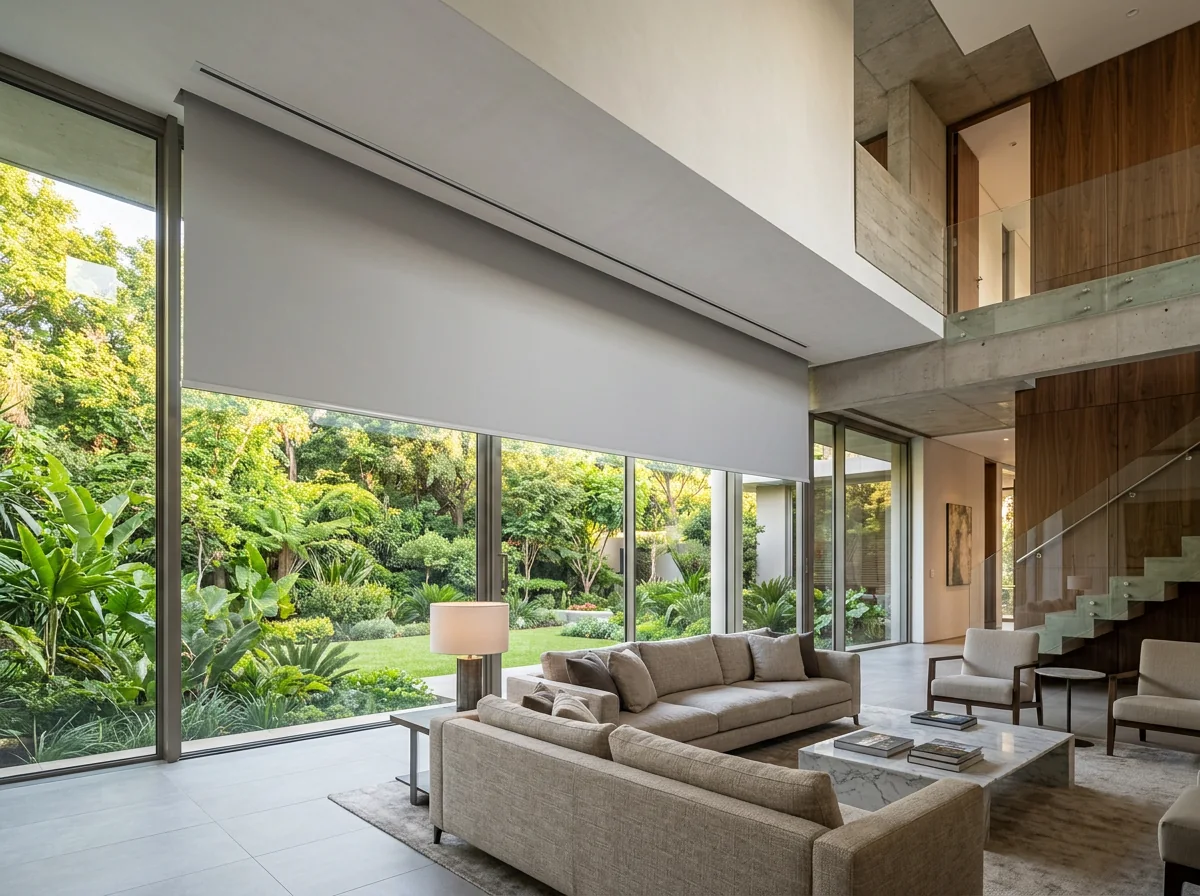
The blind drops from a slim ceiling slot with the hardware hidden, so the ceiling line stays unbroken and the window reads as glass alone. In a double volume it is usually the only tidy way to reach that upper glass at all.
The trade-off, both ways: it must be decided before the ceiling closes, wants a recess around 110–150 mm and a power point in the void, and it is the most expensive way to hang a blind — on a finished house a slim surface cassette gets close.
The slot in the ceiling is the only hardware you ever see — which is why it has to be planned early.
The deck and the veranda — zip screens and awnings do different jobs
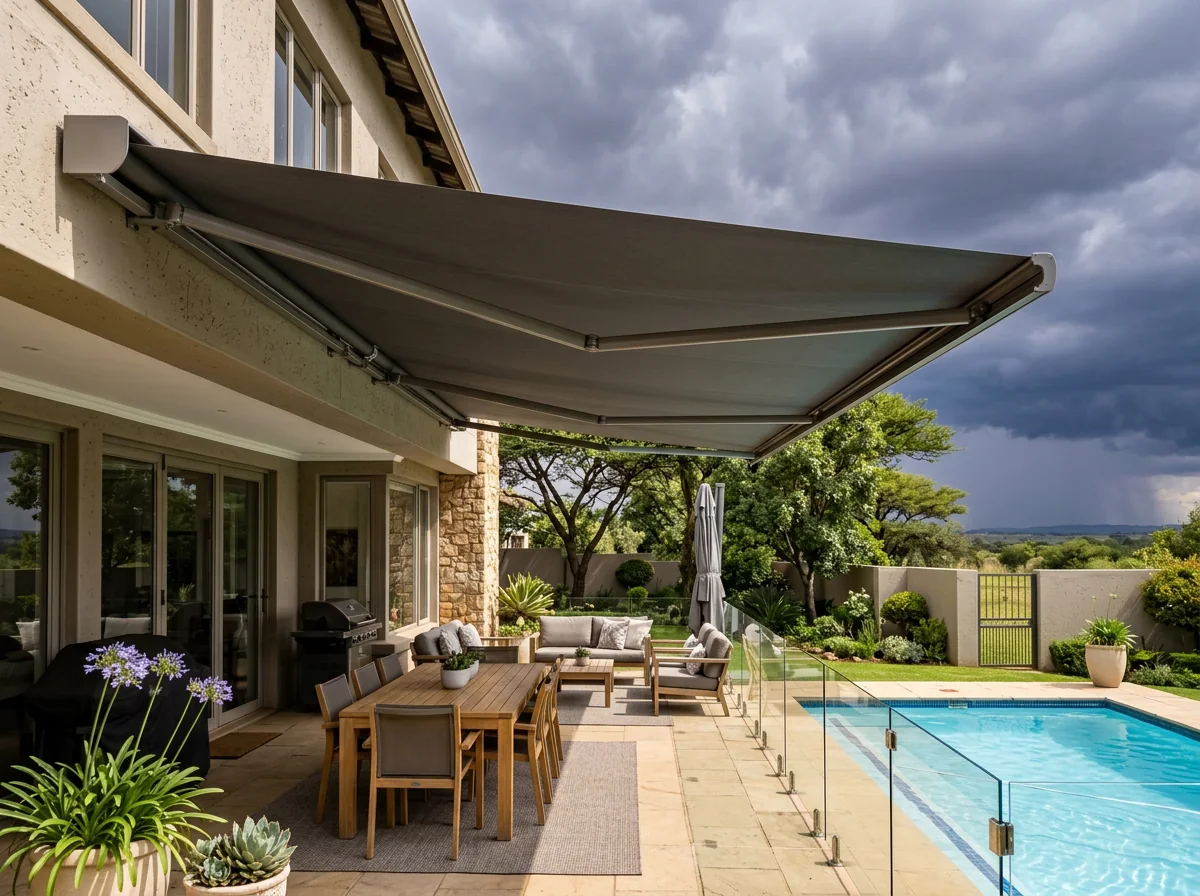
An awning gives post-free shade overhead, over a table. A zip screen runs tensioned fabric in side channels down a vertical opening and stays taut instead of flapping — which is what turns a veranda into a usable room.
The trade-off, both ways: an awning is the wrong product for a windy August afternoon, and a screen gives no overhead cover — most areas here want one of each. Highveld storms run October to March and Gauteng sees more hail than most of the country, so any motorised exterior system wants a wind sensor that retracts it before the storm.
October to March on the highveld: the wind sensor decides whether an exterior system survives its first serious storm.
Studies and formal rooms in the older houses — timber venetians
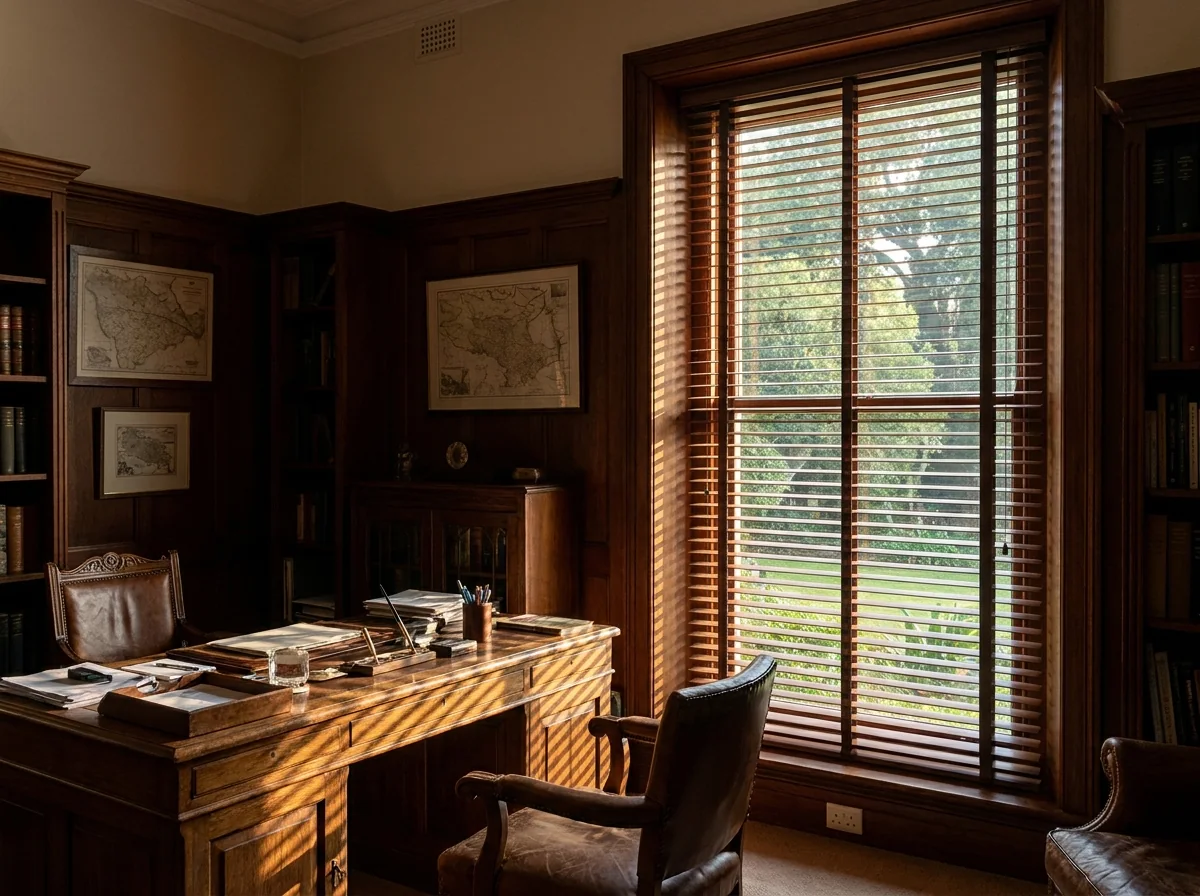
Basswood or bamboo slats sit with the joinery of a 1950s or 1960s house in a way an aluminium slat does not, and tilting slats give fine control over a low east sun crossing a desk.
The trade-off, both ways: timber dislikes steam and splash, so bathrooms and kitchens belong to aluminium. And a wide window in timber gets heavy — past a certain width it wants splitting into two blinds on one headrail.
The stripe on the desk is the point: you steer the light rather than switching it off.
Cold rooms — cellular (honeycomb) blinds
June and July nights here average roughly 3.6–3.9 °C, with light frost on the city's outskirts. Honeycomb cells trap air, so the blind insulates both ways and stacks to almost nothing. The trade-off: cellular doesn't tilt — to keep looking out while cutting the sun, a venetian or sunscreen roller is better.
Motorisation — on any of the above
It pays on anything above reach, in a double volume or gable, too wide for a chain, or that has to react to sun and wind while you're out. The trade-off: it adds cost per blind and needs a battery you'll recharge or a power point planned early — on a small, easily reached window it is a nice-to-have, and we'll say so.
Want this marked up for your own house?
Tell us which rooms and elevations are the problem and we'll send the almanac back with notes against your windows — no visit, nothing to sign.
Five
Estate lines, 60-year lines, and the tree that isn't there in July
Estates and cluster developments
The security estates and clusters here generally run architectural guidelines, and anything visible from outside — an external louvre, a shutter headbox, an awning colour or projection — goes past an architectural committee. Submitting a specification before production beats unwinding one afterwards, and we're happy to draw it up.
Anything built before about 1966
Section 34(1) of the National Heritage Resources Act says no person may alter or demolish a structure older than 60 years without a permit from the relevant provincial heritage resources authority — and "alter" covers work affecting a building's appearance. It applies by age alone; the house needn't be a declared heritage site. Hyde Park was declared residential in 1955, so its founding-era houses are around seventy years old. If you're changing the outside of one, call the provincial authority or your architect first. We fit blinds, not heritage applications — but we'd rather raise it early.
The tree that isn't there in July
Much of the canopy here is deciduous, jacaranda included: leaves drop in late winter and the flowers arrive on near-bare branches around October. So a room can look perfectly shaded on a January visit and be the worst glare room in the house in July. We judge a room on its orientation and on what the tree actually is — not on the shade that happens to be there.
Six
What we'd still need to check on site
Everything above can be reasoned from an address and an orientation. These five cannot — which is why the free measure exists.
The reveal itselfExact depth, and whether the opening is square. Wide steel-frame sliders are often a few millimetres out corner to corner, which decides inside-versus-outside mount and whether side channels can seal.
What is behind the plasterA lintel, a steel, solid brick, or a drywall bulkhead with nothing in it. That decides the fixing, the bracket and sometimes the product — and no photograph shows it.
Real wind exposure at that cornerAugust and September are Johannesburg's windiest months. An awning on a sheltered north veranda and the same awning on an exposed west corner are not the same specification.
Power and control routingWhere a motor's power comes from, where the isolator lands, and how blinds group so one elevation moves together.
The ceiling voidReal void depth, and where the downlights, beams, ducting and sprinklers already sit — the most common reason a concealed blind becomes a surface cassette.
Seven
Two ways forward — whichever suits you
Recommended
The free measure & written quote visit
A consultant comes to you with samples, measures every opening, works through the five checks above and specifies room by room. You get an itemised written quote, per window — no charge, no obligation.
Pop rough sizes into the window ledger below and we'll send a budget range by the next working day. Not sure how to measure? Leave it — our consultant measures for free and you'll get exact per-window pricing anyway.
Rough sizes are genuinely fine — this is a budget range, not a quote. Add a row per window, print it if you'd rather walk the house with paper first, and send it when you're ready. If measuring isn't your idea of a Saturday, skip the whole thing and book the free measure instead; you'll get exact per-window pricing either way.
The main event
Book your free expert measure
A consultant comes to you with samples, measures every opening precisely, walks the five on-site checks from this guide, and specifies room by room. You get a written, itemised quote per window.
Free, no obligation, and nothing decided on the day unless you want it to be.
Samples judged in your own light, at your own windows
Every opening measured — no sizes taken off a photograph
A written quote, per window, with lead times confirmed in writing
References
Sources
Every factual claim above traces to one of these. Where we could not verify something — a measured Johannesburg UV figure, for instance — we have said so in the text rather than rounding it into a statistic.