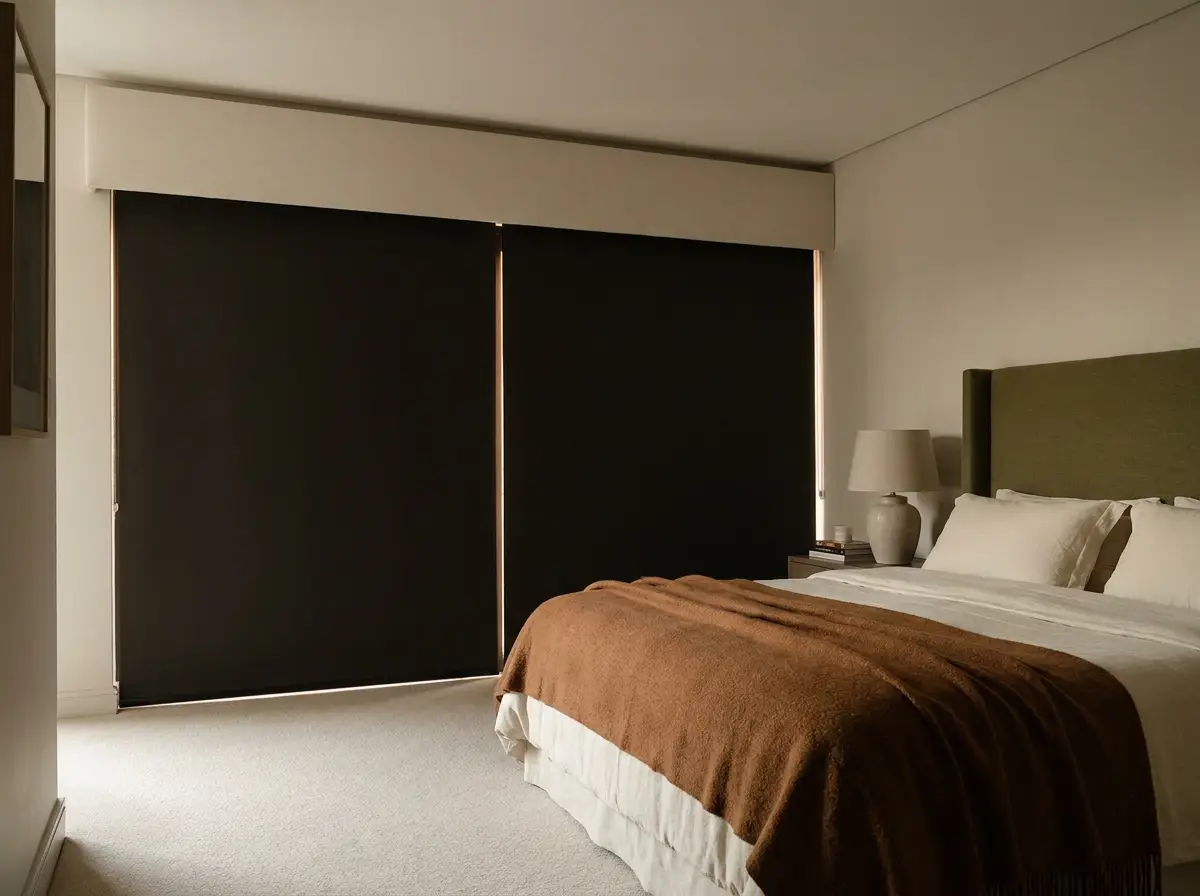
Walk a Hyde Park house in July and the problem announces itself: the winter sun sits low and level in the northern sky, and it comes straight through the big living-room glass at eye height. In December it's nearly overhead and the same room is easy. A roller blind is our usual answer to that swing precisely because the fabric — not the mechanism — can be chosen room by room.
So the measure starts at the glass. Which way does it face? Is there jacaranda canopy outside that shades it in summer and drops bare in winter? Is the neighbour's upstairs window in the sightline? The fabric decision falls out of those answers.
One honest caution on sunscreen: its privacy works in daylight only. After dark, with lamps on inside, the mesh reverses and the lit room becomes visible from the garden. In a bedroom we solve that with a double roller — sunscreen and blockout stacked on one bracket, each used at the hour it's built for.
Four things, mostly.
Not every window wants a roller. A very wide unbroken pane makes the join line a daily irritation — motorised linked blinds or a ceiling-recessed system handles it better. And in the panelled study of an older Dunkeld-side home, a timber venetian simply belongs in a way a coated fabric never will. We'd rather say that at the measure than fit the wrong thing beautifully.
Take a square metre of finished roller blind, hung and working: on a chain that is R1,000 at the plain end and R1,600 at the considered end, the difference being the cloth and whether one bracket is carrying two of them. Motorised, the same square metre runs R2,500 at the plain end and R3,800 at the considered end, with the tube motor, the control you pick and the commissioning all inside it.
The rate stops being sensible on very small openings, where a cloakroom window swallows a full tube, its own brackets and the same time on a ladder as a slider — those price to a minimum. Nor is any of it a quotation. That is written per window once the measure is done.
Roller questions
Usually 5% — enough weave density to tame the low winter sun that pours into north rooms here, while the garden stays readable through the mesh. A harsh west elevation might argue for 3%; a shaded room under jacaranda canopy can afford 10%. We bring samples of all three to the measure so you judge it in your own light, not ours.
Often, but not always — two tubes on one bracket need more depth than a single, and burglar bars or handles can steal the space. That's a tape-measure question, which is exactly why the measure is free. Where the reveal is too shallow, a face-fixed cassette above the opening does the same job cleanly.
Both, honestly ranked: sunscreen mesh cuts glare and a worthwhile share of solar gain; blockout adds an insulating layer that helps in summer and winter. But fabric inside the glass can only do so much — if a west room genuinely cooks, stopping heat outside the glass with external shading is the stronger fix, and we'll say so rather than oversell a roller.
Yes. A single rechargeable-battery motor needs no wiring and no electrician, so one hard-to-reach blind can go quiet on its own. If you think a whole wall might follow, tell us at the measure — we'll spec that first motor on a system the later blinds can join, so nothing gets thrown away.
Well — it's one of their quiet advantages. A flat sheet of fabric holds far less dust than slats or pleats, and both sunscreen and blockout wipe down with a damp cloth. No restringing, no slat-by-slat cleaning afternoons.
Where we fit these
The same per-window approach travels well: double rollers behind the deep pelmets of Dunkeld's older homes, sunscreen on the wide entertainment glass of Sandhurst, and neat cassetted blockouts in the apartments of Illovo and Melrose & Melrose Arch.
Ready when you are
Send the form and one of our expert consultants will contact you shortly to arrange your free in-home measure.
Request my call-back →